
Your data never has to leave the building.
Choose the deployment and connection model that fits the production problem, your security controls and the systems already running the factory.
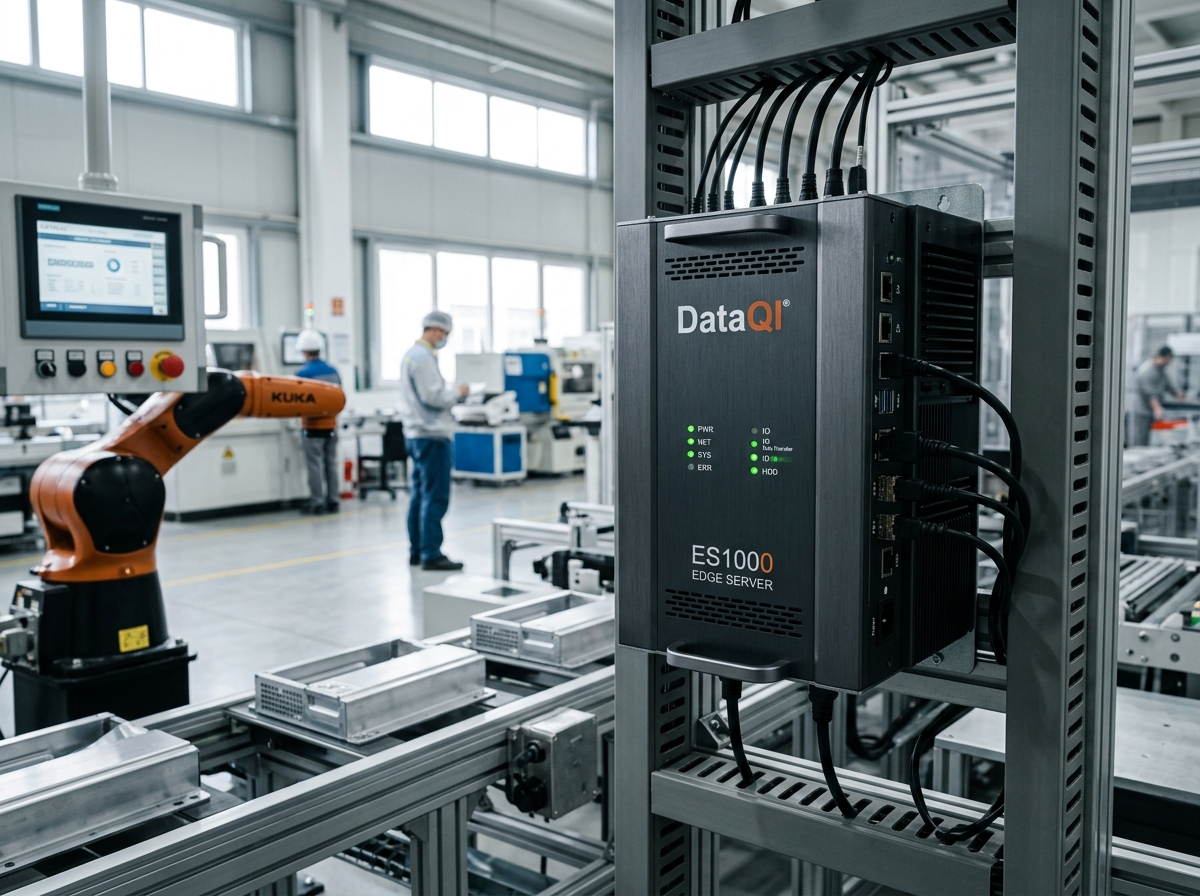
"Where does our data actually go?" is the question we hear most. Our answer: nowhere you don't want it to. DataQI can run completely on premise. Your data, your hardware, inside your own walls. For regulated or sensitive sectors, that sovereignty isn't a nice-to-have. It's the whole conversation.
no frontier model · no third-party cloud required
AI built for manufacturing
Our AI models are trained specifically on manufacturing data and industrial processes. They're trained to answer the practical questions your shop floor actually asks, not general internet queries.
Fully on premise, on your hardware or ours
Run the whole platform inside your own walls, on your own infrastructure or on the pre-configured DataQI appliance. The appliance arrives ready to run, so there is no server to provision and nothing for IT to build before the floor sees value. Data stays where it's made, encrypted and access-controlled.
Fast, lightweight AI models
Our specialised AI models run quickly on standard, cost-effective hardware, delivering fast answers on-site or in the cloud without requiring massive computing infrastructure.
Start with the smallest connection that can answer the production question.
On-site Appliance Box
Self-contained, pre-configured hardware unit installed directly on your shop floor for complete site autonomy.
On premise
Run DataQI inside your own server environment, with your data and hardware inside your walls.
UK hosted
Use a UK-hosted deployment where that fits the approved architecture and support model.
Read only first
Use existing read-only interfaces where practical. Add write-back only when the use case, permissions and change controls justify it.
Existing identity
Use existing authentication and user permissions so people see and approve only what their role allows.
Human approval
Consequential actions stop and wait for the right person. Every approval can be logged.
The questions everyone asks.
For most machines, straightforward. We integrate at the PLC over existing read-only interfaces, and on a standard asset a pilot can be capturing live data within a morning. Older or more specialist equipment takes longer: sometimes we read the signals going to its control panel, sometimes it needs a third-party sensor or a camera. Discovery settles which is which, along with access windows and rollback, before anything is agreed. Any production interruption or engineering time we need from you goes into the scope rather than being assumed away.
No. An MES runs the factory in real time; DataQI helps you learn from it over time. The two work side by side. If you don't have an MES, DataQI still stands on its own.
Deployment options include an on-premise design where operational data does not need to leave the site. The final architecture must define network boundaries, identity and access, encryption, retention, logging, backups and support responsibilities against your organisation's requirements; Razor should provide that security pack during qualification.
Assistant answers from your own data and shows its sources, so you can check where an answer came from. Agents act on what they find, but a person approves the decisions that matter before anything commits. We're deliberately sceptical of "magic" AI claims. What we build is grounded and traceable.
No. Most questions on a factory floor don't need a massive cloud AI. We use specialised AI models trained on manufacturing data that run on standard on-premise hardware, answering faster and more reliably.
They're included. Where a machine has no modern data output, we read the signals going to its control panel, use computer vision for manual processes, or add third-party sensors. No machine left behind.
No. Computer vision here is a measuring instrument, not a watchful eye. It reads timings and counts in order to improve the work, never to rank or replace the people doing it. The footage is processed on your own hardware, so frames never leave the site. The output is a better process, not a scorecard on an operator.
Insights starts making losses visible as soon as it's connected. One manufacturer found gains across their first year in hundreds of small things, most of them invisible until DataQI showed them.